What Is an Alpine Slide?
An alpine slide is a summer ride in which you steer a small wheeled sled down a long, curving chute built into the side of a hill. There is no engine, no rail, and no seat belt. Gravity does the work, a hand lever controls the speed, and a chairlift takes you back to the top.
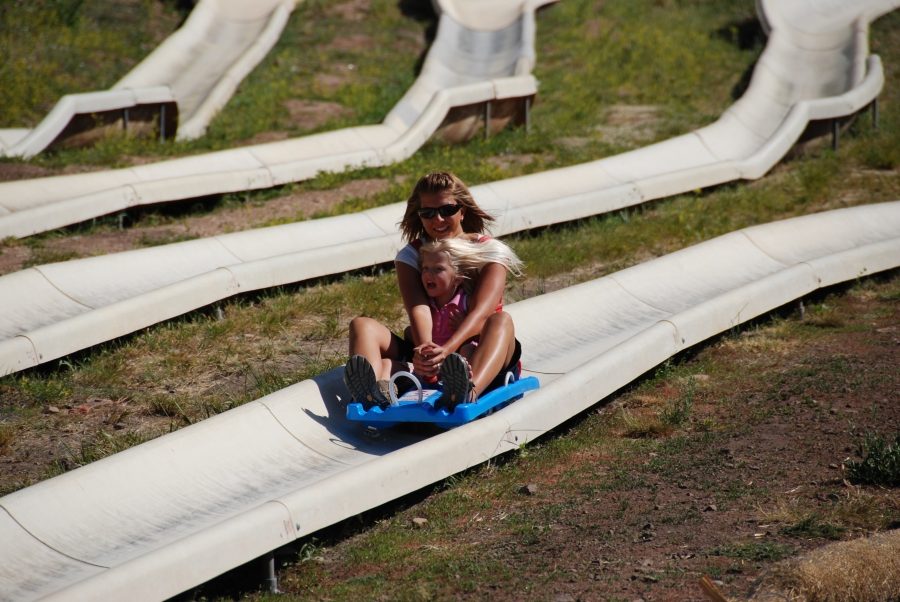
The track
The track looks like a dry bobsled run or a waterslide without water. It is a smooth, concave channel, usually made of concrete or fiberglass, laid close to the ground so that it follows the natural shape of the slope. Encyclopedic descriptions of summer toboggan rides note that alpine slide tracks are typically metal, concrete, or fiberglass, while rail-mounted coasters use tubular steel. Mt. Hood Skibowl in Oregon, for example, lists its track material as fiberglass with a protective gel coating. Alpine Slide at Magic Mountain in Big Bear Lake, California, describes its two tracks as cement.
The track winds back and forth across the hill in banked turns, S-curves, short straightaways, and sometimes dips or tunnels. Jiminy Peak in Massachusetts mentions tunnels, dips, curves, and turns on its 2,890-foot slide. Many slides have two parallel tracks so friends can ride side by side, and Bromley Mountain in Vermont runs three.
The sled
The sled is a low plastic cart with wheels or runners underneath and a control stick in the middle. Alpine Slide at Magic Mountain describes sleds with Teflon runners and ball-bearing wheels. Rushmore Tramway Adventures in South Dakota explains the most common control in plain terms: push the hand brake forward to go, pull it back to slow down and stop. Ober Gatlinburg in Tennessee calls the same idea a push-pull lever.
Because the sled sits in an open trough rather than on a rail, the rider is responsible for keeping it under control. Take a banked turn too fast and the sled can ride up the wall. That is why every operator gives a short briefing at the top and why rules about spacing, racing, and stopping on the track are taken seriously.
How fast it goes
Speed depends on the track, the rider's weight, and how much brake is used. Mt. Hood Skibowl publishes a maximum speed of 37 miles per hour on its slide and an average of 15 to 20 miles per hour. Snow King Mountain in Wyoming says riders can reach speeds up to 25 miles per hour. Rushmore Tramway Adventures says you can reach up to 40 miles per hour if you choose. In practice, most riders spend most of the trip somewhere between a gentle cruise and a brisk run, slowing for the tightest corners.
A light rider may actually have trouble going fast. A family writing for Visit Park City noticed that their younger son, technically old enough to drive his own sled, could not get it going as quickly as he wanted and chose to ride with a parent instead. The Howler Alpine Slide in Steamboat Springs sets a sled weight limit for the opposite reason: heavy combined loads create enough friction that riders can stall on flatter sections.
How long the ride is
Track lengths vary widely. Alpine Slide at Magic Mountain offers two quarter-mile tracks. Ober Gatlinburg's parallel tracks are 1,800 feet each. Mt. Hood Skibowl's is a half mile, or 2,640 feet, with a 350-foot drop. Winter Park Resort in Colorado calls its 3,000-foot slide Colorado's longest, and Park City Mountain in Utah describes its slide as more than 3,000 feet. The ride itself typically lasts a few minutes, while the whole loop, including the chairlift, takes longer. The Howler Alpine Slide suggests planning about an hour in busy periods and about half an hour when it is quiet.
Why rain closes it
Wet tracks are slippery, and slippery tracks make braking unpredictable. Operators are blunt about it. Bromley says any moisture forces the Alpine Slide to close, including dew and drizzle. Jiminy Peak says the slide cannot reopen until the track is completely dry and has been inspected. Crystal Mountain in Michigan says its slide cannot operate in the rain. If the sky looks unsettled, check the operator's status page before you drive, and plan a morning ride after the dew has burned off.
Who can ride
Most slides allow young children to ride as passengers with an adult, and set a minimum height and sometimes age for driving a sled alone. At Winter Park, riders must be at least 3 years old and 36 inches tall to ride, and at least 8 years old and 48 inches tall to drive. At Mt. Hood Skibowl, riders must be 36 inches or taller and 48 inches to ride alone. Combined weight limits on a single sled are common, often 300 pounds. Rules differ from slide to slide, so the riding with kids page gathers examples side by side.
Why ski areas build them
An alpine slide makes good use of what a ski area already has: a slope, a chairlift, a base lodge, and staff who know how to run lifts. Encyclopedic accounts of summer toboggan rides note that ski resorts often build them to put winter infrastructure to work and bring in summer income. For visitors, that means slides usually sit in the middle of a larger summer scene of scenic lift rides, hiking trails, mountain biking, and family attractions.
Alpine slide, mountain coaster, or bobsled?
The names overlap. Ober Gatlinburg calls its slide the Smoky Mountain Bobsled. Crystal Mountain calls its new slide the Crystal Coaster Alpine Slide. Meanwhile, rail-mounted mountain coasters are sometimes called alpine coasters. The difference that matters is whether the sled runs freely in a trough or is locked onto a rail. The alpine slide vs. mountain coaster page explains how that changes the ride.
Sources
- Wikipedia, Summer toboggan
- Mt. Hood Skibowl, Alpine Slide
- Alpine Slide at Magic Mountain
- Rushmore Tramway Adventures, Alpine Slide
- Ober Gatlinburg, Smoky Mountain Bobsled
- Jiminy Peak, Alpine Slide
- Winter Park Resort, Alpine Slide
- Visit Park City, Summer family fun at Park City Mountain
- Howler Alpine Slide, FAQs