Alpine Slide vs. Mountain Coaster
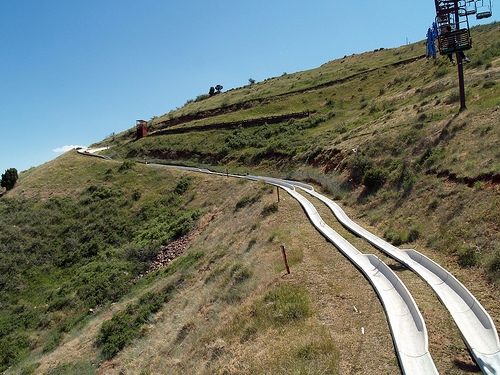
Alpine slides and mountain coasters look like cousins, and resorts sometimes blur the names. Both send you downhill in a small cart that you control with a lever. The difference is underneath you: an alpine slide sled runs freely in an open trough, while a mountain coaster cart is locked onto a steel rail.
The short answer
Encyclopedic descriptions draw the line clearly. An alpine coaster or mountain coaster is a type of roller coaster where the cart runs on rails and cannot leave the track. An alpine slide cart simply runs on a smooth, concave track, usually metal, concrete, or fiberglass. In German, both are often called a Sommerrodelbahn, or summer toboggan run, which is one reason the English names get mixed up.
How they feel
On an alpine slide, you sit low in a sled that rides up the banks of each turn. You feel the surface through the wheels, you hear the hum of the track, and you steer as much with your body position as with the lever. It is a hands-on, slightly scrappy ride, which is a big part of its charm. A family writing for Visit Park City noted that a light child had trouble leaning forward enough to get a sled going fast, a detail that tells you how much the rider matters.
A mountain coaster feels more like a small roller coaster. The cart is clamped to the rail, so it can take steeper drops, tighter spirals, and longer elevated sections without the rider worrying about riding up a wall. You still choose your speed with a brake lever, but the cart's path is fixed. Encyclopedic accounts note that alpine coaster carts are fitted with centrifugal brakes that limit maximum speed, and some newer systems add anti-collision braking.
Getting to the top
Most alpine slides use a chairlift. Winter Park riders take the Arrow chairlift; Mt. Hood Skibowl uses its Scenic Sky Chairs; Ober Gatlinburg uses the Sky Village Express; Crystal Mountain uses the Loki Quad. Many mountain coasters, by contrast, include a lift section built into the track itself, so the cart is pulled uphill on the rail before the ride down begins.
Weather
This is the difference most visitors notice. Alpine slides close when the track is wet. Bromley, Jiminy Peak, Whitefish Mountain Resort, Crystal Mountain, and Rushmore Tramway Adventures all say so plainly, and several mention morning dew. Mountain coasters are generally more tolerant of conditions, and some run through the winter. Snow King Mountain in Jackson, Wyoming, for example, calls its Cowboy Coaster a year-round mountain coaster, while its alpine slide is summer-only.
Who can ride
Both rides usually let small children ride with an adult and set a minimum height for riding alone, but the numbers differ. At Spirit Mountain in Duluth, Minnesota, which operates an alpine coaster rather than a slide, solo riders must be at least 54 inches tall. Many alpine slides let riders drive alone at 48 inches, though age minimums vary. Weight limits per cart are common on both. Always check the operator's posted rules for the specific ride.
Track length and scale
Mountain coasters are often longer. The Snowbird Mountain Coaster in Utah is described by Ski Utah as 3,120 feet, and Spirit Mountain describes its alpine coaster as 3,200 feet of elevated track. Wikipedia notes that the Mineshaft Coaster at Big Bear Lake is about a mile long. Alpine slides range from Big Bear's quarter-mile tracks to Winter Park's 3,000-foot run, which the resort calls Colorado's longest alpine slide.
When names get confusing
A few examples show why you should read the description, not just the name:
- Ober Gatlinburg's Smoky Mountain Bobsled is an alpine slide. The resort says it is also known as the Alpine Slide.
- Crystal Mountain's Crystal Coaster Alpine Slide is an alpine slide with two 1,600-foot tracks, despite the word coaster in its name.
- Mountain Creek's Alpine Mountain Coaster in New Jersey is a coaster, built after the area's original alpine slide was removed.
- Utah Olympic Park offers an Alpine Slide and, separately, a summer bobsled experience on its Olympic track, which is a different ride entirely.
Places where you can try both
Many resorts run both rides side by side, which makes for an easy comparison in a single afternoon:
- Park City Mountain, Utah: the Mountain Village Adventure Park lists an Alpine Slide and a Mountain Coaster.
- Breckenridge Ski Resort, Colorado: Alpine Slides and the Gold Runner Coaster at Epic Discovery.
- Purgatory Resort, Colorado: the Alpine Slide and the Inferno Mountain Coaster.
- Snow King Mountain, Wyoming: the Alpine Slide and the Cowboy Coaster.
- Alpine Slide at Magic Mountain, California: the namesake slide and the Mineshaft Coaster.
Which should you choose?
Choose the alpine slide if you want the classic, low-to-the-ground feel and a ride where your own control really shapes the experience. It is a great first thrill ride for children who have reached passenger age, and it tends to suit families who want to ride together in parallel tracks. Choose the mountain coaster if the forecast is unsettled, if you want bigger drops and longer runs, or if someone in the group prefers the reassurance of a cart fixed to a rail. At resorts with both, the best answer is usually to ride each once and decide which one deserves the second lap.
Sources
- Wikipedia, Summer toboggan
- Snow King Mountain, Cowboy Coaster
- Spirit Mountain, Adventure Park
- Ski Utah, Snowbird listings
- Wikipedia, Alpine Slide at Magic Mountain
- Ober Gatlinburg, Smoky Mountain Bobsled
- Crystal Mountain, Crystal Coaster Alpine Slide
- Mountain Creek, Alpine Mountain Coaster
- Park City Mountain, Hours of Operation
- Purgatory Resort, Alpine Slide