An alpine slide is one of the simplest pleasures a mountain can offer in summer. You ride a chairlift up a green ski slope, sit on a small wheeled sled, and steer yourself down a winding, banked chute with a single hand lever that decides how fast you go. AlpineSlide.com is a guide to those rides in the United States and to the summer mountain trips that grow up around them.
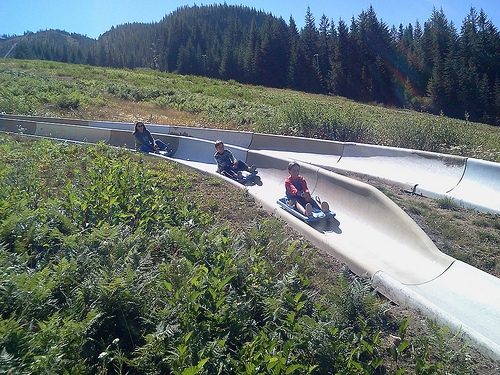
Most alpine slides live at ski areas. When the snow melts, the lifts keep turning for hikers, mountain bikers, and families, and the slide gives the mountain a reason to be busy in the warm months. A few sit at standalone attraction parks, such as the one at Big Bear Lake in California or the tramway park near Mount Rushmore in South Dakota. Either way, the ride is short, the views are long, and almost everyone gets off at the bottom wanting to go again.
Start here
What an alpine slide is
The sled, the track, the brake lever, and why rain closes the ride.
The basicsAlpine slide directory
Slides across the country listed by state, with links to each operator.
DirectorySlide or coaster?
How a concrete or fiberglass chute differs from a rail-mounted mountain coaster.
CompareRiding fast, riding smart
How to enjoy speed without bumping, rolling, or scraping a knee.
Riding tipsWhere the slides are
Alpine slides are spread thinly across the map, so they are easiest to think about by region. The Northeast has historic slides in Vermont, Massachusetts, and Pennsylvania. Colorado and Utah hold the biggest cluster, from Winter Park and Breckenridge to Durango, Steamboat Springs, and Park City. The northern Rockies add Jackson Hole and Whitefish, near two of the country's best-known national parks, and the Black Hills add a slide a short drive from Mount Rushmore. On the West Coast you will find slides at Big Bear Lake and on Mount Hood. The Midwest and South have more than many people expect, with slides on Minnesota's North Shore, above the Mississippi River in Illinois, in northern Michigan, and in the Great Smoky Mountains of Tennessee.
- Northeast alpine slides: Vermont, the Berkshires, and the Laurel Highlands.
- Colorado and Utah: the deepest bench of slides, at high altitude.
- Northern Rockies and the Black Hills: Wyoming, Montana, and South Dakota.
- California and the Pacific Northwest: Big Bear Lake and Mount Hood.
- Midwest and South: Minnesota, Illinois, Michigan, and Tennessee.
What a day at a slide looks like
A visit usually starts at a ticket window or an activity desk near the base lodge. Many operators ask every rider to sign a liability waiver, and some sell rides one at a time while others bundle the slide into an all-day activity pass with a mountain coaster, ropes course, mini golf, or bungee trampolines. From there you ride a chairlift partway or all the way up the hill. Staff at the top hand you a sled, explain the lever, and send riders off with a gap between them. The ride down takes a few minutes, and the chairlift takes you back up for the next lap.
Because the tracks are open to the sky, weather runs the show. Most operators close the slide whenever the track is wet, even from morning dew, and reopen once it has dried. Lightning closes nearly everything on a mountain. Height and age rules decide who drives a sled and who rides as a passenger with an adult. None of this is hard to plan around once you know it, and the pages on riding with kids and planning a mountain-resort trip walk through it.
A summer vacation built around a slide
An alpine slide is rarely the only reason to visit a mountain town, and that is part of the fun. The slide at Snow King Mountain sits in the town of Jackson, a short drive from Grand Teton National Park. Whitefish Mountain Resort describes itself as a base camp for Glacier National Park. Purgatory Resort is in the San Juan Mountains outside Durango, the gateway town for Mesa Verde National Park and the narrow gauge railroad to Silverton. Ober Mountain overlooks Gatlinburg, the northern gateway to Great Smoky Mountains National Park. Rushmore Tramway Adventures is in Keystone, the town closest to Mount Rushmore National Memorial.
That makes the slide a natural reward on a road trip: a few laps in the afternoon after a morning of hiking, a rainy-day backup plan once the track dries, or an easy outing for grandparents and grandchildren together. See national parks near alpine slides and family summer attractions near slides for ideas.
Learn the story
Summer toboggan rides grew out of the European Alps, where the German name Sommerrodelbahn, or summer toboggan run, is still used for both slides and coasters. The concrete and fiberglass chute that Americans call an alpine slide arrived at ski areas in the 1970s, and some of those early tracks still carry riders. The history of alpine slides page covers the German engineering behind the first designs, the slides that made ski areas into summer destinations, and the rail-mounted mountain coasters that followed.
Before you go
Operating days, hours, rules, and ticket options are set by each operator and can change with the weather. Every listing on this site links to the operator's own page, which is the place to confirm whether the slide is running on the day you plan to visit. A quick call or a look at the mountain's activity status page saves a wasted drive, especially in shoulder seasons, when many slides run only on weekends.
The how to find alpine slides page explains what to look for in an operator's listing and how to tell a true alpine slide from a mountain coaster when the names blur together.
Sources
- Snow King Mountain, Alpine Slide
- Whitefish Mountain Resort, Glacier National Park
- Purgatory Resort, Alpine Slide
- Ober Gatlinburg, Smoky Mountain Bobsled
- Rushmore Tramway Adventures, Alpine Slide
- Bromley Mountain, Hours of Operation