Adrenaline Junkies Welcome: Riding Fast, Riding Smart
Alpine slides reward riders who like speed. With the brake lever pushed forward and a clear track ahead, a sled can move surprisingly quickly through banked turns. The trick to enjoying that speed is understanding the track, respecting the rules, and knowing when to ease off.
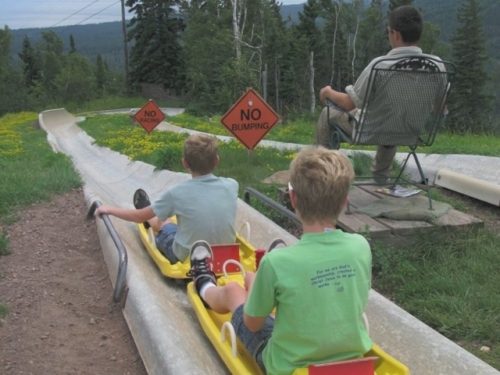
Know how fast it can go
Operators publish real numbers, and they are higher than many first-time riders expect. Mt. Hood Skibowl lists a maximum speed of 37 miles per hour with an average of 15 to 20. Snow King Mountain says up to 25 miles per hour. Rushmore Tramway Adventures says riders can reach up to 40 miles per hour if they choose. That is plenty of excitement in an open sled sitting a few inches off the ground.
Racing is not part of the deal
It is tempting to line up next to a friend on parallel tracks and race to the bottom, but operators are clear that racing is not allowed. Mt. Hood Skibowl's posted rules say no bumping, racing, or stopping on the track. Rushmore Tramway Adventures lists "Do not race" among its restrictions. Ask the staff at the top about any slide's specific rules, and treat side-by-side tracks as a chance to ride together, not a starting line.
Bumping the rider ahead is another hard no. A collision in an open trough can throw a rider off a sled or pin a hand. Staff at the top space riders apart for a reason, and the safest habit is to keep that gap all the way down. If you catch up to a slower rider, brake and let the space reopen.
How to go fast without losing control
- Brake before the turn, not in it. Slow down on the straight leading into a tight corner, then ease off as you come out. Braking hard in the middle of a banked turn can unsettle the sled.
- Sit centered and lean in. Keep your weight in the middle of the sled. Leaning slightly forward helps a sled carry speed on flatter sections, which is why light riders sometimes struggle to go fast.
- Keep hands and feet inside. The track walls and edges are hard. Hands belong on the lever, feet belong in the sled.
- Read the signs. Slides often post slow-down markers before the trickiest sections. Respect them on every lap, including the fifth.
- Do not stop on the track. A sudden stop creates a hazard for the rider behind you. If you have a problem, follow the operator's instructions.
Leave the camera in the pocket
Filming a ride seems harmless, but it takes a hand off the lever and attention off the track. Mt. Hood Skibowl's rules specifically prohibit hand-held cameras or video while sliding. Many riders find that the chairlift ride up is the better moment for photos, with both hands free and a view of the whole course below.
Dress for scrapes
The old AlpineSlide.com crew earned more than one scraped knee from pushing a sled too hard through a high-banked corner. The lesson still holds: wear clothes that protect your skin. Shorts are common in summer, but long, sturdy fabric guards against abrasions if you brush the track. Closed-toe shoes are a good idea, and Purgatory Resort and Chestnut Mountain both recommend them. Tie back long hair, remove loose scarves, and stash anything that could fall out of a pocket. Ober Gatlinburg asks riders to check for loose clothing and equipment before they ride.
Helmets and protective gear
Older guides sometimes told readers that riders should always wear helmets on alpine slides and should avoid any slide that does not provide them. That advice does not match how the slides in this guide operate. Their posted alpine slide rules do not list helmets; they focus on rider briefings, speed control, spacing, weather closures, and height and weight limits instead. If you want to wear your own protective gear, ask the operator first, since some equipment may not fit safely in a sled.
Sober and in control
Ride only when you are clear-headed. Rushmore Tramway Adventures says every rider must ride safely, sober, and in control, and that anyone impaired by alcohol or drugs may be removed from the slide. Many alpine slides sit near mountain bars and beer gardens, so plan the slide first and the celebration afterward.
Respect the weather
A wet track is slippery and unpredictable, which is why operators close slides for rain, drizzle, mist, and even morning dew. Lutsen Mountains in Minnesota lists rain, mist, dense fog, and lightning as reasons to close. Do not argue with a closure. Wait it out, ride the scenic lift, or come back once the track has dried and staff have inspected it.
Know your limits, and your passengers'
When an adult rides with a small child, the adult controls the sled for two, and some operators require that the adult be able to fully operate the brake lever with a passenger aboard. Carrying a child is not the moment to chase a personal best. Combined weight limits apply too, often 300 pounds per sled. See riding with kids for examples of operator rules.
The fastest way to enjoy it
The riders who have the most fun usually take a first lap slowly to learn the track, then add speed on each run. By the third trip you will know where the tight corners are, where the track opens up, and where you can let the sled run. That knowledge, more than any trick, is what turns a good ride into a great one.
Sources
- Mt. Hood Skibowl, Alpine Slide
- Snow King Mountain, Alpine Slide
- Rushmore Tramway Adventures, Alpine Slide
- Purgatory Resort, Alpine Slide
- Chestnut Mountain Resort, Alpine Slide
- Ober Gatlinburg, Smoky Mountain Bobsled
- Lutsen Mountains, Alpine Slide